




 Follow
Mattresses are one of the biggest investment of our life given it is something we sleep on every single day. Buying a good quality mattress promises you sound sleep, proper spine alignment, body support, and relief from back pain and neck pain. While selecting a poor-quality mattress can invite some serious health problems. So, here is your easy, step-by-step mattress-buying guide to help you choose the best mattress for yourself.
The first deciding factor in any mattress buying guide is to first check the size of your bed. Simply take a measuring tape and stretch it in a straight line across your length and then on breadth. Match the values you get with the following bed size measurement table (India):
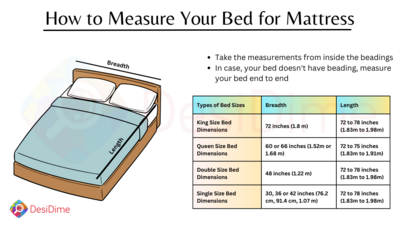
Types of Bed Sizes |
Breadth |
Length |
King Size Bed Dimensions |
72 inches (1.8 m) |
72 to 78 inches (1.83m to 1.98m) |
Queen Size Bed Dimensions |
60 or 66 inches (1.52m or 1.68 m) |
72 to 75 inches (1.83m to 1.91m) |
Double Size Bed Dimensions |
48 inches (1.22 m) |
72 to 78 inches (1.83m to 1.98m) |
Single Size Bed Dimensions |
30, 36 or 42 inches (76.2 cm, 91.4 cm, 1.07 m) |
72 to 78 inches (1.83m to 1.98m) |
Note: The numbers mentioned above are approx estimates. Your mattress size may also differ from brand to brand so be sure to check the brand size measurements while buying a mattress online.
Thinking to give your old bed or sofa a break and get a new one? Checkout these best deals on sofas, beds, and furniture
Furniture Offers, Coupons & Deals
Mattress Type |
Body Weight |
Coir Mattress |
<100 Kgs |
Spring Mattress |
>100 Kgs |
Memory Foam Mattress |
>80 Kgs |
HR Foam Mattress |
50 to <100Kgs |
PU Foam Mattress |
>50 to 80Kgs |
Latex Mattress |
Can be used by both lightweight & overweight people |
Bonded Foam Mattress |
>100 Kgs |
Note: These are only rough estimates. A general rule of thumb is the heavier you are, the more firm (but supportive) mattress you may need.
Also, the body weight estimates mentioned are as per the natural feel and construction of the particular foam. If you are buying a multi-layered foam mattress, the values may change.
For example, if you are a heavy-weight individual with more than 80 kg body weight, you can still use a memory foam mattress until and unless it has other firm layers of foam to support such as bonded foam or HR foam. Ideally, for overweight or obese people, a memory foam of 1 inch does the work of providing just enough amount of cushioning.
Important Tip: If you are purchasing a mattress online, be sure to check the body weight capacity, usually shared in product details.
Mattress Type |
Firmness Level |
Coir Mattress |
Medium |
Spring Mattress |
High |
Memory Foam Mattress |
Low |
HR Foam Mattress |
Medium to High |
PU Foam Mattress |
Medium to High |
Latex Mattress |
Medium |
Bonded Foam Mattress |
High |
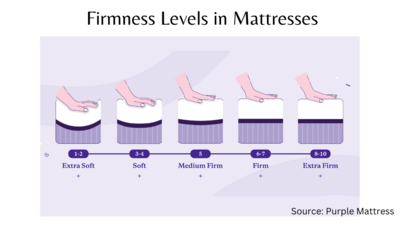
Note: When buying a mattress offline, be sure to check the firmness level of your mattress by pressing the palm of your hand against the mattress.
But, how do you check the firmness level of a mattress online? Most brands include details on the firmness level of their mattress, ranging from low, medium, to high. Be sure to check it when buying a mattress.
A general rule of thumb to keep in mind is, the heavier someone is (and if you have back pain) the more they should prefer to buy a firm mattress that doesn’t sag or sulk in too much due to the weight and in turn putting more strain over the spine, neck, or back.
Foam density (generally denoted as “D” or Kg per cubic meter) is also a good indicator of how firm the mattress may be. There are different density foams such as 28D, 32D, 40D, and 80D. The higher the density of the foam, the more firm it would be. Density is also at times linked with durability.
Mattress Type |
Best For |
|---|---|
Coir Mattress |
Mild back pain, Scoliosis, lower backache (not recommended for long-term) |
Spring Mattress |
Airflow & heat dissipation (cooling), heavy sleepers, support for spine, neck, muscles & joints, back pain relief |
Memory Foam Mattress |
Blood circulation, chronic back and neck pain, spine alignment, cozy sleep, side sleepers, |
HR Foam Mattress |
Durability, back pain relief, moderate to slightly overweight people |
PU Foam Mattress |
Affordability (not recommended due to health-related problems) |
Latex Mattress |
Pain relief (no off-gassing too as in synthetic foams), best for senior citizens, spine alignment, freshness, motion isolation (useful if you are sleeping with a partner), best for babies |
Bonded Foam Mattress |
Obese or overweight people, belly sleepers, can serve orthopedic purposes |
Note: If you have a serious medical condition, you must consider your family doctor to identify which orthopedic mattress would be the best fit for you. For general health-related problems, you can refer to the table above.
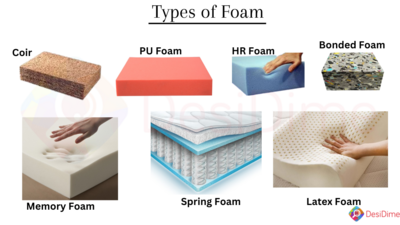
Coir and Latex are 2 popular choices when it comes to selecting natural mattresses. Foam mattresses are mostly synthetic and made from petrochemicals. So keep this in mind when buying a sleeping mattress.
Mattress Type |
Price |
Coir Mattress |
💸💸💸 |
Spring Mattress |
💸💸💸💸 |
Memory Foam Mattress |
💸💸💸💸 |
HR Foam Mattress |
💸💸💸 |
PU Foam Mattress |
💸💸 |
Latex Mattress |
💸💸💸💸💸 |
Bonded Foam Mattress |
💸💸💸💸 |
One of the most important factors to consider when buying a mattress is your budget. Mattresses range from as little as Rs.1000 to as high as 1.5 Lakhs+. You can also mix and match different foam layers as per your requirements to suit your budget.
Tip: At Desidime, we are India’s biggest online shopping community. We and our expert dimers often post some amazing money-saving deals on mattresses & furniture. Be sure to check out them here:
Best Deals on Mattresses Online!
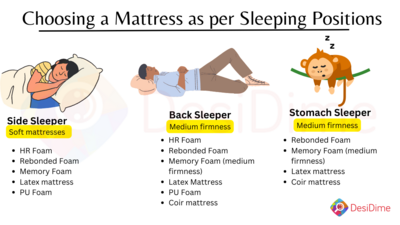
Your sleeping position is another important factor to consider when buying a mattress. If you are someone who is a side sleeper, you may benefit from a mattress that is soft and conforms to the contours of your body. Whereas if you are a back sleeper, you would ideally require a mattress that has a medium firmness to support your back. Choosing a too-soft mattress in such a case will put a strain on your spine. Lastly, for all belly sleepers, a mattress that is medium firm is ideally suitable as it can provide adequate support to your body to not let yourself sink in too much and off-balance your spine alignment.
Sleeping Position |
Ideal softness or firmness |
Side Sleepers |
Soft firmness |
Back Sleepers |
Medium firmness |
Stomach Sleepers |
Medium firmness |
Mattress Type |
Softness Level |
Motion Isolation |
Humidity Dissipation |
Durability |
Prone to dust, mites, & bed bugs (more🪲= more resistance) |
Coir Mattress |
Low to Medium |
Medium to High |
Good |
2 to 5 Years |
🪲🪲🪲 |
Spring Mattress |
Low to Medium |
Low |
Good |
5 to 8 Years |
🪲🪲 |
Memory Foam Mattress |
Medium to High |
High |
Poor |
8 to 12 Years |
🪲🪲🪲🪲 |
HR Foam Mattress |
Low to Medium |
Medium to High (open cell) |
Good (open cell) |
8 to 10 Years |
🪲🪲🪲🪲 |
PU Foam Mattress |
Medium to High |
Low |
Poor |
7 to 15 Years & above (HR foams) |
🪲🪲🪲 |
Latex Mattress |
Medium to High |
Medium |
Good |
8 to 20 Years |
🪲🪲🪲🪲🪲 |
Bonded Foam Mattress |
Low to Medium |
Medium to High |
Poor |
5 to 7 Years |
🪲🪲🪲🪲 |
Depending on your usage, you may require certain extra features such as extra softness, motion isolation, breathability or heat dissipation, etc.
😴Motion isolation in mattresses in simple words is the ability of your mattress to absorb weight and motion. Imagine you are sleeping with someone who tends to move around a lot in sleep. Motion isolation mattresses ensure that body movements aren’t felt across the bed.
☁️Softness levels in Mattresses: Everyone has a different preference for how soft, plush or firm they like their mattress to be. Some people like firm mattresses for back support. While some may like soft or extra plush mattresses that give a luxurious, cozy feel.
❄️Heat dissipation in Mattresses: Heat dissipation in mattresses is the ability of mattresses to manage heat. This determines how airy/cool or humid your mattress would be to sleep in. Some mattresses like Memory Foam generate more heat as compared to others like Latex
💪Durability of Mattresses: The durability of a mattress depends on factors such as its density (the more denser a mattress is, the more durable it is generally), and material composition (certain foams like memory foams are more durable as compared to natural mattress material Coir), mattress thickness (generally, the thicker a mattress is, the more durable it is and the less it sags in long-term), and last but not least, the construction of the mattress (how many & what type of layers of foams it has) Spring mattresses are less durable as compared to pure latex mattresses
🪲Dust, Bugs, Mites & Other Allergens in Mattresses: Like many other parts of our house, mattresses are good storage spaces for bugs, mites, and other allergens. These seemingly teeny-tiny bugs and mites live, eat, defecate, and sleep in your mattress (yup, in the same one you bought for thousands of bucks!) Allergens like dust, bugs, and mites can cause some serious health issues like asthma, infection, and more. Some mattresses like pure latex are naturally antimicrobial while some mattresses like innerspring mattresses, PU Foams, or even coir are more susceptible to bugs.
Tip: To tackle this problem, brands generally put an extra layer of antimicrobial foam shield to resist any growth of bugs, mites or dust. So when buying a mattress, be sure to check for this factor in your mattress.
Today, mattress manufacturing has become more advance with new technologies such as profiling, inserting cool gel particles, cool gel foams, antimicrobial shield foams etc to further customise your mattress.
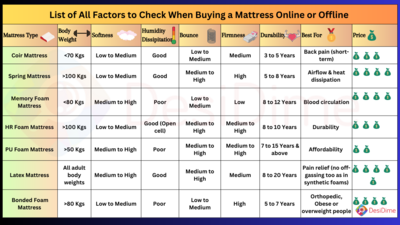
Mattress on Buying Guide - List of All Factors to Check When Buying a Mattress Online or Offline | |||||||||
Mattress Type |
Body Weight |
Softness |
Humidity Dissipation |
Bounce |
Firmness |
Durability |
Brands available |
Best For |
Price |
Coir Mattress |
<70 Kgs |
Low to Medium |
Good |
Low to Medium |
Medium |
3 to 5 Years |
Duroflex, Nilkamal, Kurlon |
Back pain (short-term) |
💸💸💸 |
Spring Mattress |
>100 Kgs |
Low to Medium |
Good |
Medium to High |
High |
5 to 8 Years |
Wakefit, Duroflex, Sleepwell |
Airflow & heat dissipation |
💸💸💸💸 |
Memory Foam Mattress |
<100 Kgs |
Medium to High |
Poor |
Low to Medium |
Low |
8 to 12 Years |
Wakefit, SleepyCat, Seepyhead, The Sleep Company |
Blood circulation |
💸💸💸💸 |
HR Foam Mattress |
>50 Kgs |
Low to Medium |
Good (Open cell) |
Medium to High |
Medium to High |
8 to 10 Years |
Amore, Springtek, Wakefit |
Durability |
💸💸💸 |
PU Foam Mattress |
>50 Kgs |
Medium to High |
Poor |
Medium to High |
Medium to High |
7 to 15 Years & above |
SleepyCat, Seepyhead, Duroflex |
Affordability |
💸💸 |
Latex Mattress |
All adult body weights |
Medium to High |
Good |
Medium to High |
Medium |
8 to 20 Years |
Sunday, Springtek, Wakefit |
Pain relief (no off-gassing too as in synthetic foams) |
💸💸💸💸💸 |
Bonded Foam Mattress |
>80 Kgs |
Low to Medium |
Poor |
Low to Medium |
High |
5 to 7 Years |
Springtek, Kurlon |
Orthopedic, Obese or overweight people |
💸💸💸💸 |
Following are some of the most common types of foams used in mattresses along with their pros and cons, health benefits and issues as well as foam feel and firmness.
PU Foam is divided into 2 types, open-cell & closed-cell. Open-cell PU Foams are more breathable while closed-cell PU Foams have more thermal conductivity, and are more rigid and robust which is why they are mostly used outdoors.
Talking about PU foam mattress health issues, PU foam mattresses are possibly the worst for health as they release gases of Volatile Organic Compound (VOC). The main ingredient used while manufacturing PU foam mattresses is methylene diphenyl diisocyanate [MDI] and/or toluene diisocyanate [TDI]) both of which are made from the main ingredient, isocyanate.
Think you have heard the name “isocyanate” before? Well yes, remember the 1984 Bhopal tragedy where 40 tons of methyl isocyanate gas was leaked & killed 3000+ people? I don’t think we need to explain any further just how harmful PU foam mattresses can be to health.
Foam feel: PU Foam’s firmness mostly depends on the variety of it but most PU Foams are low to moderately soft in nature with moderate to high firmness. PU Foam mattresses are best for superficial back pain relief, and instant comfort.
Pros & Cons:
PU Foam Advantages |
PU Foam Disadvantages |
Economical |
Release of chemical odor & fumes of VOC (off-gassing issue) |
Good thermal dispersion (open cell) |
Poor support to spine or body |
Strong and Durable (closed-cell) |
More prone to allergens and dust |
Provides instant superficial relief to mild back pain |
Best use-cases:
PU Foams mattresses are best used for the following use cases.
Mattress for back pain relief (instant mild back pain relief)
Best to use as a layer in mattresses
High-resilience Foam or HR Foam is also a blend of Polyurethane. As compared to PU Foam, HR Foam has more density which makes it great to provide support to people with joint pains and back pain. It is also, a good choice of mattress for overweight people as the firmness and high density of HR Foam are capable of evenly distributing the weight and pressure.
HR Foam feel: HR Foam is a high-resilience foam that helps provide a bounce to the mattress. Being made from PU foam, it still provides a low to moderate softness depending on the density. HR foam as compared to memory foam has a much quicker response time.
Pros & Cons:
HR Foam Advantages |
HR Foam Disadvantages |
Best for heavy sleepers due to its density, firmness and bounce |
Heavier in weight than other foam mattresses |
Doesn’t easily sag |
Chemical off-gassing |
Great comfort & airflow (open-cell) |
No motion isolation (your body movements are felt across the mattress) |
High durability |
Best use-cases:
HR Foams mattresses are best used for the following use cases.
Best Mattress for back pain relief
Best mattress for support to joint pains
Best mattress for heavy sleepers, side, and back sleepers
Memory Foam mattress like any other foam mattress is made from petrochemicals like Polyurethane with some extra chemicals that increase its density and viscosity. This is why memory foam mattress is also referred to as viscoelastic polyurethane foam or low-resilience polyurethane foam.
How to check memory foam quality?
Memory foam quality can be checked by its density and its ILD (Indentification Load Deflection). A higher density memory foam such as 32D upwards and with an ILD between 10 to 50 is more likely to last longer. To find a healthier alternative to traditional memory foam mattresses, you can buy an eco-friendly memory foam mattress made from plant-based materials or you can look for “low-VOC” certified memory foam mattresses.
Memory Foam feel: Memory foam has a super soft, body-hugging feel to it. Imagine sleeping on a fluffy cotton-like cloud which as per your body weight, makes your body sink in a bit and gives your body a soft, plush feel. Memory as compared to others has a much slower response time which is why it has a very low level of bounce.
Pros & Cons:
Memory Foam Advantages |
Memory Foam Disadvantages |
Great motion isolation |
Generates heat (can be fixed by adding a cool-gel layer of foam) |
Less back and neck pain due it being viscoelastic |
Being a PU Foam, it generates VOC |
Best for blood circulation, and spine alignment |
Not recommended for babies under 2 years |
Great for back sleepers and side sleepers |
Not suitable for heavy sleepers (unless combined with other foam layers, eg: Bonded foam) |
High durability |
|
It is best for press points relief for body parts such as the back, neck, hips, knees, shoulders, etc |
|
Because of being more denser, it is less susceptible to bugs, mites, and dust. |
Best use-cases:
Memory Foams mattresses are best used for the following use cases.
Best mattress for pressure points relief
Best mattress for spine alignment
Best mattress for back pain, body ache, and neck pain
Best mattress for side sleepers.
Best mattress for old-age adults and seniors
Check out this Amazon’s No.1 Best Seller in Mattresses:
Orthopaedic Memory Foam Mattress with 10-years warranty Under Rs.15,000
Moving on with our Mattress Buying Guide, we have one of the most preferred mattress materials which is latex. Latex mattresses are made from the sap of rubber trees. This gives our friend, Latex some really cool qualities to possess such as being naturally antimicrobial, having a natural bounce and softness to it and lastly being super-friendly to the skin and our health, unlike foam mattresses.
How to check natural latex mattresses online (or offline)?
Ensure your latex mattress is certified with GOLS (Global Organic Latex Standards)
You can also check for other certifications such as ECO Institut Tested Product to ensure its quality of being from pollutants and Oeko Tex Certification to ensure the product is free of harmful substances
The number of years of warranty. Generally, a pure latex mattress has a warranty of 15 years, 20 Years, or above
The density of a natural latex mattress ranges from 60 kg/m3 to about 95 kg/m3
Latex mattress feel: Latex mattress is made from the sap of a rubber tree, has an inherent bounce to it. The sap extracted is filled in a container, made to expand by vacuum, made ventilation holes into, baked, and then cooled. This process makes Latex a super breathable mattress, soft in feel and yet with a bounce or high responsive rate, unlike memory foam.
Pros & Cons:
Natural Latex Mattress Pros |
Latex Cons |
All-natural which ensures a healthy sleep |
More expensive |
Good for pain relief and spine alignment |
Slight rubbery smell initially |
Good for all kinds of sleepers |
Not lightweight to carry |
Excellent breathability |
May be synthetic if bought without checking its quality and authenticity |
Excellent durability |
|
More responsive than memory foam mattress |
|
Hypoallergic (resistant to bugs, mites, etc) |
Best use-cases:
Natural Latex mattresses are best used for the following use cases.
Best mattress for back pain, neck pain, and body pain relief
Best mattress for spine alignment
Best mattress for back sleepers, side sleepers, and belly sleepers
Best mattress for couples due to its disturbance absorbency
Best mattress for overweight people
Recommendation for all natural GOL and GOT certified latex mattress in India: Orthoganic Luxury Mattress
Spring Foam Mattress comes in 4 different types: pocketed, offset coil, Bonnel coil, & continuous coil. A general rule of thumb is the higher the number of coils, the better support.
Pocketed coils are also called Marshall Coils. These are round-shaped coils wrapped in fabric. Pocketed coils are more expensive and are suitable for heavy sleepers as well as those who sleep on their stomach.
Bonnel Coil spring mattresses are more economical and more cooling. However, due to their hourglass structure, they aren’t more durable.
Offset Coils spring mattresses are more durable and their structure is designed to provide stability and firmness. If you are slightly overweight and have back and joint ache issues, an offset spring mattress can be a good choice.
Continuous Coils as compared to Bonnel coils or Offset coils are more supportive and cary more weight. These spring mattresses are known for their density and high durability.
Spring Mattress Feel: As the name suggests, spring mattresses have more bounce to them and can support individuals with a heavy weight. Because of their construction, these spring mattresses are perfect for people with joint pain, body pain, or back support. The firmness and softness of a spring mattress depend can vary and be customized at different levels.
Pros & Cons:
Spring Mattress Pros |
Spring Mattress Cons |
Good for back support |
Lack of durability in certain spring mattresses |
Best in Budget |
More susceptible to bugs, mites, and dust |
High breathability |
May not be suitable for side sleepers |
Good for heavy sleepers |
May get noisy with time |
Best use-cases:
Spring mattresses are best used for the following use cases.
Best mattress for back support
Best mattress for breathability and freshness
Innerspring and hybrid mattresses are best for heavy-weight people
Coir mattresses are another natural mattress material that is produced after soaking coconut husks in water for a few days and then beaten in a disintegrator to prepare coir fibers. These coir fibers then are used to make coir mattresses. Coir mattresses are available for cheap prices. However, they have a lesser life span.
Coir Mattress Feel: Despite being made from coconut husks, coir mattresses possess a medium to low soft feel with moderate to high firmness. There’s little to no bounce that you’d get to experience sleeping in a coir mattress.
Pros & Cons:
Coir Mattress Pros |
Coir Mattress Cons |
Made naturally |
Shorter life span |
Provide instant superficial relief to back pain |
May sag if put heavy weight upon for long-term |
Cheaply available |
Not the most hygienic |
Easy home for bugs, mites, and other allergens |
|
Not recommended to use in long-term for back pain issues |
Best use-cases:
Coir mattresses are best used for the following use cases.
Best mattress for being cheap and economical
Bonded foam mattresses or rebonded foam mattresses are made from scraps of PU Foam (Polyurethane foam). This makes the bonded foam extra firm as well as super economical to purchase. Bonded foams by themselves are no good for health but if they are often combined with other foams such as memory foam, they can prove to be great for some orthopedic benefits such as for providing back support, as well as a strong base for your mattress.
Because Bonded foams are super dense in nature, they are less likely to be home to bugs, mites, and dust.
Bonded foam Mattress Feel: Bonded foams are made by gluing pieces of PU Foam together. This is why bonded foams are firmer and tougher in feel. They possess little to no softness. Due to being super dense, they also have little to no bounce
Pros & Cons:
Bonded Mattress Pros |
Bonded Mattress Cons |
Good for back support (if layered with other foams) |
May generate heat |
Also called orthopedic mattresses |
May feel too firm to some people |
Economical |
Less durable due to its construction process |
Resist bugs, & allergens |
Best use-cases:
Bonded mattresses are best used for the following use cases (If combined with another supportive foam layer):
Best orthopedic mattress
Best mattress for back support
Best mattress for resisting bugs, allergens, and dust.
So, this was all about sharing how to choose a mattress for sleeping, back pain, spine alignment & other causes. In this detailed mattress buying guide, we have tried to cover all the possible details and factors to consider when buying a mattress online or offline.
We will soon bring an article featuring our top 10 picks for the best mattresses in India. Please share with us suggestions in the comments below what else would you like us to review and if you know of any super amazing mattresses?

 I am unable to understand the rating system used under "Prone to dust,mites & bed bugs" category in point 7 though.Can you please elaborate? Thanks!
 2
2
 1
1























![Top 20+ Diwali Sale Offers India 2026 [ Amazon, Flipkart, Acer & more ]](https://cdn3.desidime.com/attachments/photos/3552635/large/DiwaliSaleOffersIndia2026AmazonFlipkartAcermore.png?1791989870)
Congratulations @vrushali.s on entering into Deal Lieutenant Club 🥳🌟👏🏻
🥳🌟👏🏻  🎊
🎊
Thank you @quantum even i had not realized it...
Great share bro... It would be more helpful if you have shared suggestions for purchasing mattress along with the links
I am copy paste doing this in family friend relative whatsapp groups.
Super
But you forgot our age old , tried and tested and offline make to order Rui ka Gadda , cotton made mattress.
Yes, our age-old, tried and tested cotton-made Gadda or mattress is one of the most economical solutions. However sadly, our poor fellow is not the best solution for our long-term body posture and health.
Hope this answered your question.
Mattresses are one of the biggest investment of our life given it is something we sleep on every single day. Buying a good quality mattress promises you sound sleep, proper spine alignment, body support, and relief from back pain and neck pain. While selecting a poor-quality mattress can invite some serious health problems. So, here is your easy, step-by-step mattress-buying guide to help you choose the best mattress for yourself.
The first deciding factor in any mattress buying guide is to first check the size of your bed. Simply take a measuring tape and stretch it in a straight line across your length and then on breadth. Match the values you get with the following bed size measurement table (India):
Types of Bed Sizes
Breadth
Length
King Size Bed Dimensions
72 inches (1.8 m)
72 to 78 inches (1.83m to 1.98m)
Queen Size Bed Dimensions
60 or 66 inches (1.52m or 1.68 m)
72 to 75 inches (1.83m to 1.91m)
Double Size Bed Dimensions
48 inches (1.22 m)
72 to 78 inches (1.83m to 1.98m)
Single Size Bed Dimensions
30, 36 or 42 inches (76.2 cm, 91.4 cm, 1.07 m)
72 to 78 inches (1.83m to 1.98m)
Note: The numbers mentioned above are approx estimates. Your mattress size may also differ from brand to brand so be sure to check the brand size measurements while buying a mattress online.
Furniture Offers, Coupons & Deals
Mattress Type
Body Weight
Coir Mattress
<100 Kgs
Spring Mattress
>100 Kgs
Memory Foam Mattress
>80 Kgs
HR Foam Mattress
50 to <100Kgs
PU Foam Mattress
>50 to 80Kgs
Latex Mattress
Can be used by both lightweight & overweight people
Bonded Foam Mattress
>100 Kgs
Note: These are only rough estimates. A general rule of thumb is the heavier you are, the more firm (but supportive) mattress you may need.
Also, the body weight estimates mentioned are as per the natural feel and construction of the particular foam. If you are buying a multi-layered foam mattress, the values may change.
For example, if you are a heavy-weight individual with more than 80 kg body weight, you can still use a memory foam mattress until and unless it has other firm layers of foam to support such as bonded foam or HR foam. Ideally, for overweight or obese people, a memory foam of 1 inch does the work of providing just enough amount of cushioning.
Important Tip: If you are purchasing a mattress online, be sure to check the body weight capacity, usually shared in product details.
Mattress Type
Firmness Level
Coir Mattress
Medium
Spring Mattress
High
Memory Foam Mattress
Low
HR Foam Mattress
Medium to High
PU Foam Mattress
Medium to High
Latex Mattress
Medium
Bonded Foam Mattress
High
Note: When buying a mattress offline, be sure to check the firmness level of your mattress by pressing the palm of your hand against the mattress.
But, how do you check the firmness level of a mattress online? Most brands include details on the firmness level of their mattress, ranging from low, medium, to high. Be sure to check it when buying a mattress.
A general rule of thumb to keep in mind is, the heavier someone is (and if you have back pain) the more they should prefer to buy a firm mattress that doesn’t sag or sulk in too much due to the weight and in turn putting more strain over the spine, neck, or back.
Mattress Type
Best For
Coir Mattress
Mild back pain, Scoliosis, lower backache (not recommended for long-term)
Spring Mattress
Airflow & heat dissipation (cooling), heavy sleepers, support for spine, neck, muscles & joints, back pain relief
Memory Foam Mattress
Blood circulation, chronic back and neck pain, spine alignment, cozy sleep, side sleepers,
HR Foam Mattress
Durability, back pain relief, moderate to slightly overweight people
PU Foam Mattress
Affordability (not recommended due to health-related problems)
Latex Mattress
Pain relief (no off-gassing too as in synthetic foams), best for senior citizens, spine alignment, freshness, motion isolation (useful if you are sleeping with a partner), best for babies
Bonded Foam Mattress
Obese or overweight people, belly sleepers, can serve orthopedic purposes
Note: If you have a serious medical condition, you must consider your family doctor to identify which orthopedic mattress would be the best fit for you. For general health-related problems, you can refer to the table above.
Coir and Latex are 2 popular choices when it comes to selecting natural mattresses. Foam mattresses are mostly synthetic and made from petrochemicals. So keep this in mind when buying a sleeping mattress.
Mattress Type
Price
Coir Mattress
💸💸💸
Spring Mattress
💸💸💸💸
Memory Foam Mattress
💸💸💸💸
HR Foam Mattress
💸💸💸
PU Foam Mattress
💸💸
Latex Mattress
💸💸💸💸💸
Bonded Foam Mattress
💸💸💸💸
One of the most important factors to consider when buying a mattress is your budget. Mattresses range from as little as Rs.1000 to as high as 1.5 Lakhs+. You can also mix and match different foam layers as per your requirements to suit your budget.
Your sleeping position is another important factor to consider when buying a mattress. If you are someone who is a side sleeper, you may benefit from a mattress that is soft and conforms to the contours of your body. Whereas if you are a back sleeper, you would ideally require a mattress that has a medium firmness to support your back. Choosing a too-soft mattress in such a case will put a strain on your spine. Lastly, for all belly sleepers, a mattress that is medium firm is ideally suitable as it can provide adequate support to your body to not let yourself sink in too much and off-balance your spine alignment.
Sleeping Position
Ideal softness or firmness
Side Sleepers
Soft firmness
Back Sleepers
Medium firmness
Stomach Sleepers
Medium firmness
Mattress Type
Softness Level
Motion Isolation
Humidity Dissipation
Durability
Prone to dust, mites, & bed bugs (more🪲= more resistance)
Coir Mattress
Low to Medium
Medium to High
Good
2 to 5 Years
🪲🪲🪲
Spring Mattress
Low to Medium
Low
Good
5 to 8 Years
🪲🪲
Memory Foam Mattress
Medium to High
High
Poor
8 to 12 Years
🪲🪲🪲🪲
HR Foam Mattress
Low to Medium
Medium to High (open cell)
Good (open cell)
8 to 10 Years
🪲🪲🪲🪲
PU Foam Mattress
Medium to High
Low
Poor
7 to 15 Years & above (HR foams)
🪲🪲🪲
Latex Mattress
Medium to High
Medium
Good
8 to 20 Years
🪲🪲🪲🪲🪲
Bonded Foam Mattress
Low to Medium
Medium to High
Poor
5 to 7 Years
🪲🪲🪲🪲
Depending on your usage, you may require certain extra features such as extra softness, motion isolation, breathability or heat dissipation, etc.
Tip: To tackle this problem, brands generally put an extra layer of antimicrobial foam shield to resist any growth of bugs, mites or dust. So when buying a mattress, be sure to check for this factor in your mattress.
Mattress Type
Body Weight
Softness
Humidity Dissipation
Bounce
Firmness
Durability
Brands available
Best For
Price
Coir Mattress
<70 Kgs
Low to Medium
Good
Low to Medium
Medium
3 to 5 Years
Duroflex, Nilkamal, Kurlon
Back pain (short-term)
💸💸💸
Spring Mattress
>100 Kgs
Low to Medium
Good
Medium to High
High
5 to 8 Years
Wakefit, Duroflex, Sleepwell
Airflow & heat dissipation
💸💸💸💸
Memory Foam Mattress
<100 Kgs
Medium to High
Poor
Low to Medium
Low
8 to 12 Years
Wakefit, SleepyCat, Seepyhead, The Sleep Company
Blood circulation
💸💸💸💸
HR Foam Mattress
>50 Kgs
Low to Medium
Good (Open cell)
Medium to High
Medium to High
8 to 10 Years
Amore, Springtek, Wakefit
Durability
💸💸💸
PU Foam Mattress
>50 Kgs
Medium to High
Poor
Medium to High
Medium to High
7 to 15 Years & above
SleepyCat, Seepyhead, Duroflex
Affordability
💸💸
Latex Mattress
All adult body weights
Medium to High
Good
Medium to High
Medium
8 to 20 Years
Sunday, Springtek, Wakefit
Pain relief (no off-gassing too as in synthetic foams)
💸💸💸💸💸
Bonded Foam Mattress
>80 Kgs
Low to Medium
Poor
Low to Medium
High
5 to 7 Years
Springtek, Kurlon
Orthopedic, Obese or overweight people
💸💸💸💸
Following are some of the most common types of foams used in mattresses along with their pros and cons, health benefits and issues as well as foam feel and firmness.
PU Foam is divided into 2 types, open-cell & closed-cell. Open-cell PU Foams are more breathable while closed-cell PU Foams have more thermal conductivity, and are more rigid and robust which is why they are mostly used outdoors.
Talking about PU foam mattress health issues, PU foam mattresses are possibly the worst for health as they release gases of Volatile Organic Compound (VOC). The main ingredient used while manufacturing PU foam mattresses is methylene diphenyl diisocyanate [MDI] and/or toluene diisocyanate [TDI]) both of which are made from the main ingredient, isocyanate.
Foam feel: PU Foam’s firmness mostly depends on the variety of it but most PU Foams are low to moderately soft in nature with moderate to high firmness. PU Foam mattresses are best for superficial back pain relief, and instant comfort.
Pros & Cons:
PU Foam Advantages
PU Foam Disadvantages
Economical
Release of chemical odor & fumes of VOC (off-gassing issue)
Good thermal dispersion (open cell)
Poor support to spine or body
Strong and Durable (closed-cell)
More prone to allergens and dust
Provides instant superficial relief to mild back pain
Best use-cases:
PU Foams mattresses are best used for the following use cases.
Mattress for back pain relief (instant mild back pain relief)
Best to use as a layer in mattresses
High-resilience Foam or HR Foam is also a blend of Polyurethane. As compared to PU Foam, HR Foam has more density which makes it great to provide support to people with joint pains and back pain. It is also, a good choice of mattress for overweight people as the firmness and high density of HR Foam are capable of evenly distributing the weight and pressure.
HR Foam feel: HR Foam is a high-resilience foam that helps provide a bounce to the mattress. Being made from PU foam, it still provides a low to moderate softness depending on the density. HR foam as compared to memory foam has a much quicker response time.
Pros & Cons:
HR Foam Advantages
HR Foam Disadvantages
Best for heavy sleepers due to its density, firmness and bounce
Heavier in weight than other foam mattresses
Doesn’t easily sag
Chemical off-gassing
Great comfort & airflow (open-cell)
No motion isolation (your body movements are felt across the mattress)
High durability
Best use-cases:
HR Foams mattresses are best used for the following use cases.
Best Mattress for back pain relief
Best mattress for support to joint pains
Best mattress for heavy sleepers, side, and back sleepers
Memory Foam mattress like any other foam mattress is made from petrochemicals like Polyurethane with some extra chemicals that increase its density and viscosity. This is why memory foam mattress is also referred to as viscoelastic polyurethane foam or low-resilience polyurethane foam.
Memory Foam feel: Memory foam has a super soft, body-hugging feel to it. Imagine sleeping on a fluffy cotton-like cloud which as per your body weight, makes your body sink in a bit and gives your body a soft, plush feel. Memory as compared to others has a much slower response time which is why it has a very low level of bounce.
Pros & Cons:
Memory Foam Advantages
Memory Foam Disadvantages
Great motion isolation
Generates heat (can be fixed by adding a cool-gel layer of foam)
Less back and neck pain due it being viscoelastic
Being a PU Foam, it generates VOC
Best for blood circulation, and spine alignment
Not recommended for babies under 2 years
Great for back sleepers and side sleepers
Not suitable for heavy sleepers (unless combined with other foam layers, eg: Bonded foam)
High durability
It is best for press points relief for body parts such as the back, neck, hips, knees, shoulders, etc
Because of being more denser, it is less susceptible to bugs, mites, and dust.
Best use-cases:
Memory Foams mattresses are best used for the following use cases.
Best mattress for pressure points relief
Best mattress for spine alignment
Best mattress for back pain, body ache, and neck pain
Best mattress for side sleepers.
Best mattress for old-age adults and seniors
Moving on with our Mattress Buying Guide, we have one of the most preferred mattress materials which is latex. Latex mattresses are made from the sap of rubber trees. This gives our friend, Latex some really cool qualities to possess such as being naturally antimicrobial, having a natural bounce and softness to it and lastly being super-friendly to the skin and our health, unlike foam mattresses.
Latex mattress feel: Latex mattress is made from the sap of a rubber tree, has an inherent bounce to it. The sap extracted is filled in a container, made to expand by vacuum, made ventilation holes into, baked, and then cooled. This process makes Latex a super breathable mattress, soft in feel and yet with a bounce or high responsive rate, unlike memory foam.
Pros & Cons:
Natural Latex Mattress Pros
Latex Cons
All-natural which ensures a healthy sleep
More expensive
Good for pain relief and spine alignment
Slight rubbery smell initially
Good for all kinds of sleepers
Not lightweight to carry
Excellent breathability
May be synthetic if bought without checking its quality and authenticity
Excellent durability
More responsive than memory foam mattress
Hypoallergic (resistant to bugs, mites, etc)
Best use-cases:
Natural Latex mattresses are best used for the following use cases.
Best mattress for back pain, neck pain, and body pain relief
Best mattress for spine alignment
Best mattress for back sleepers, side sleepers, and belly sleepers
Best mattress for couples due to its disturbance absorbency
Best mattress for overweight people
Spring Foam Mattress comes in 4 different types: pocketed, offset coil, Bonnel coil, & continuous coil. A general rule of thumb is the higher the number of coils, the better support.
Spring Mattress Feel: As the name suggests, spring mattresses have more bounce to them and can support individuals with a heavy weight. Because of their construction, these spring mattresses are perfect for people with joint pain, body pain, or back support. The firmness and softness of a spring mattress depend can vary and be customized at different levels.
Pros & Cons:
Spring Mattress Pros
Spring Mattress Cons
Good for back support
Lack of durability in certain spring mattresses
Best in Budget
More susceptible to bugs, mites, and dust
High breathability
May not be suitable for side sleepers
Good for heavy sleepers
May get noisy with time
Best use-cases:
Spring mattresses are best used for the following use cases.
Best mattress for back support
Best mattress for breathability and freshness
Innerspring and hybrid mattresses are best for heavy-weight people
Coir mattresses are another natural mattress material that is produced after soaking coconut husks in water for a few days and then beaten in a disintegrator to prepare coir fibers. These coir fibers then are used to make coir mattresses. Coir mattresses are available for cheap prices. However, they have a lesser life span.
Coir Mattress Feel: Despite being made from coconut husks, coir mattresses possess a medium to low soft feel with moderate to high firmness. There’s little to no bounce that you’d get to experience sleeping in a coir mattress.
Pros & Cons:
Coir Mattress Pros
Coir Mattress Cons
Made naturally
Shorter life span
Provide instant superficial relief to back pain
May sag if put heavy weight upon for long-term
Cheaply available
Not the most hygienic
Easy home for bugs, mites, and other allergens
Not recommended to use in long-term for back pain issues
Best use-cases:
Coir mattresses are best used for the following use cases.
Best mattress for being cheap and economical
Bonded foam mattresses or rebonded foam mattresses are made from scraps of PU Foam (Polyurethane foam). This makes the bonded foam extra firm as well as super economical to purchase. Bonded foams by themselves are no good for health but if they are often combined with other foams such as memory foam, they can prove to be great for some orthopedic benefits such as for providing back support, as well as a strong base for your mattress.
Bonded foam Mattress Feel: Bonded foams are made by gluing pieces of PU Foam together. This is why bonded foams are firmer and tougher in feel. They possess little to no softness. Due to being super dense, they also have little to no bounce
Pros & Cons:
Bonded Mattress Pros
Bonded Mattress Cons
Good for back support (if layered with other foams)
May generate heat
Also called orthopedic mattresses
May feel too firm to some people
Economical
Less durable due to its construction process
Resist bugs, & allergens
Best use-cases:
Bonded mattresses are best used for the following use cases (If combined with another supportive foam layer):
Best orthopedic mattress
Best mattress for back support
Best mattress for resisting bugs, allergens, and dust.
So, this was all about sharing how to choose a mattress for sleeping, back pain, spine alignment & other causes. In this detailed mattress buying guide, we have tried to cover all the possible details and factors to consider when buying a mattress online or offline.
We will soon bring an article featuring our top 10 picks for the best mattresses in India. Please share with us suggestions in the comments below what else would you like us to review and if you know of any super amazing mattresses?
Also Read: Things to Consider When Buying a House in India