




 Follow
Google Pay users will now have to pay a convenience fee ranging (depends on utility bill category) from 0.5-1% + GST when making utility bill payments of any amount using credit or debit cards. Earlier, low-amount utility bill payments were free from convenience fees via credit/debit cards! This change applies to a wide range of transactions, including:
Mobile recharges
Electricity bills
Gas bills
DTH/Cable TV payments
FASTag recharges
Google Play transactions
Broadband/Landline bill payments
Other utility bill payments
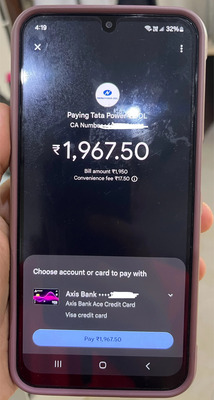
2 months back, Dimer @devanshdalmia1531 noticed ₹17.50 convenience fee (0.75%+GST) while paying ₹1,967.50 electricity bill via his Axis Bank Ace Credit Card. However, 5 days prior to this notice, he paid an electricity bill via this same credit card without any convenience fee!
Users opting to pay directly from their bank accounts via UPI (Unified Payments Interface) will not be charged any convenience fee. This makes UPI payments an attractive alternative for users looking to avoid additional charges. However, it excludes mobile recharges! For mobile recharges via UPI, the following fee structure is there on Google Pay:
No fee on recharges below ₹100
Flat ₹1.9 (inclusive of GST) platform fee on recharges above ₹100
UPI transactions between users and merchants incur a processing cost of around 0.25% of the transaction value. Due to this, many UPI apps, including Google Pay, have started imposing a platform/convenience fee to cover these operational costs.
As digital payments evolve, these changes highlight the growing trend of platforms monetizing transaction services that were previously free. Users should remain aware of these charges when choosing their preferred payment method.


 2
2
 2
2
 1
1


Closed Axis Ace Ass 🍑 since GPay started these charges and got Airtel Axe 🪓
4





















For now, GPAY has removed convenience fee for only Axis Ace CC
Closed Axis
AceAss 🍑 since GPay started these charges and got Airtel Axe 🪓Me to Google pay : 🥲
expect transactions tax in 2030.
Offline recharge shops ask for cash.
.do you ready to pay cash instead of cc for recharge ?
Thanks for the mention!
Google Pay users will now have to pay a convenience fee ranging (depends on utility bill category) from 0.5-1% + GST when making utility bill payments of any amount using credit or debit cards. Earlier, low-amount utility bill payments were free from convenience fees via credit/debit cards! This change applies to a wide range of transactions, including:
Mobile recharges
Electricity bills
Gas bills
DTH/Cable TV payments
FASTag recharges
Google Play transactions
Broadband/Landline bill payments
Other utility bill payments
2 months back, Dimer @devanshdalmia1531 noticed ₹17.50 convenience fee (0.75%+GST) while paying ₹1,967.50 electricity bill via his Axis Bank Ace Credit Card. However, 5 days prior to this notice, he paid an electricity bill via this same credit card without any convenience fee!
Users opting to pay directly from their bank accounts via UPI (Unified Payments Interface) will not be charged any convenience fee. This makes UPI payments an attractive alternative for users looking to avoid additional charges. However, it excludes mobile recharges! For mobile recharges via UPI, the following fee structure is there on Google Pay:
No fee on recharges below ₹100
Flat ₹1.9 (inclusive of GST) platform fee on recharges above ₹100
UPI transactions between users and merchants incur a processing cost of around 0.25% of the transaction value. Due to this, many UPI apps, including Google Pay, have started imposing a platform/convenience fee to cover these operational costs.
As digital payments evolve, these changes highlight the growing trend of platforms monetizing transaction services that were previously free. Users should remain aware of these charges when choosing their preferred payment method.